Chinook salmon
Oncorhynchus tshawytscha
Chinook, or king salmon, are the largest fish in Michigan rivers, averaging 12 to 13 pounds on the Muskegon and arriving in catchable numbers by mid-August as rivers and the nearshore lake cool into the 60s. The run peaks from mid-September through the first week of October, when the Little Manistee weir takes its eggs, and the Manistee, Pere Marquette and St. Joseph are the DNR's named best stream fisheries. Kings stop feeding once they enter the river and strike out of aggression, so fresh chrome fish near the mouth take swung or stripped streamers on 9- and 10-weights while staged fish in October take dead-drifted eggs and Egg-Sucking Leeches. Native to the Pacific from California to Alaska, Chinook were introduced to the Great Lakes by Michigan in 1967; today most Chinook caught in Lakes Michigan and Huron are wild, produced mostly in Michigan tributaries and trending upward. They roam the whole lake, and many Lake Huron fish feed in Lake Michigan, but in fall each returns to the stream where it was stocked or hatched. Their drifting eggs are the single most important food event of the year for steelhead and resident trout.
Ours, from the Two Hearted. Each took a fly we tied.
© Quinn · CC BY · iNaturalist · Michigan · 2025
© Russell Parsons · CC BY · iNaturalist · Manistee County, MI · 2024
© George Pushkal · CC BY · iNaturalist · Wawatam Township, MI · 2024
© Quinn · CC BY · iNaturalist · Laketon Township, MI 49445 · 2022
© Jenny Saito · CC BY · iNaturalist · NZ-CA, NZ · 2024
© Owen Strickland · CC BY · iNaturalist · Toronto, ON · 2019
What they eat in the river
Lake diet is alewife (99 percent by one DNR account) with some smelt. Bloater are now the most abundant forage fish in Lake Michigan, but USGS surveys find no evidence that salmon or trout eat them. On the spawning run the DNR states salmon do not feed but will often strike out of aggression, and fisheries biologists attribute strikes to redd defense. Anglers nonetheless take Chinook on eggs and beads presented behind spawners, and on large dark or bright flies that trigger territorial strikes. Do not match diet; match triggers.
- does not feed in the river; strikes from aggression and redd defense
- J
- F
- M
- A
- M
- J
- J
- A
- S
- O
- N
- D
- Evidence
- S
- eggs and beads taken behind spawning fish, Egg-Sucking Leeches, dark Woolly Buggers, Intruders in chartreuse, red, orange, black and blue
- J
- F
- M
- A
- M
- J
- J
- A
- S
- O
- N
- D
- Evidence
- A
| Food | Months | Evidence |
|---|---|---|
| does not feed in the river; strikes from aggression and redd defense |
| S |
| eggs and beads taken behind spawning fish, Egg-Sucking Leeches, dark Woolly Buggers, Intruders in chartreuse, red, orange, black and blue |
| A |
Runs and spawn
On the listed salmon rivers (Betsie, Bear Creek, Manistee below Tippy, Big Sable, Pere Marquette, Little Manistee, White, Muskegon below Croton, Pentwater branches) terminal gear from August 1 to November 15 is limited to single hooks or jigs of half-inch gap or less; snagging is illegal statewide. A 2027 stocking cut is planned but will not change river presence through at least 2028.
Staple flies
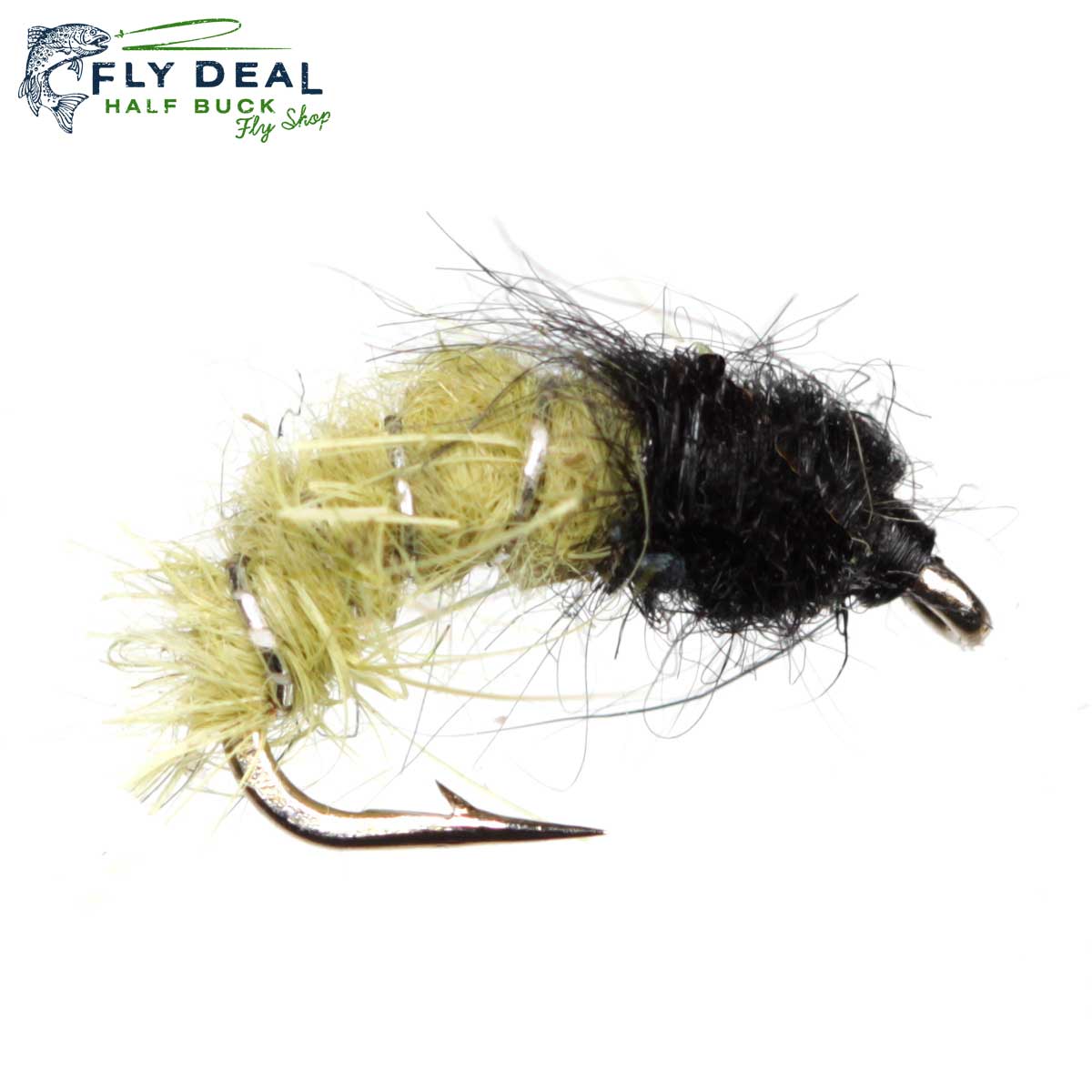 Reference photo
A Michigan steelhead staple: the green Rhyacophila larva is 'effective on the Muskegon River for steelhead' and Current Works lists caddis #6 to #12 among its top five, bright green or chartreuse for stained water and olive or cream naturals for low clear flows. Betts names green caddis larvae with Hex nymphs and eggs on the Pere Marquette flies-only water. Fish it as the trailer behind an egg or stonefly, year-round.
Indicator nymphing · Chuck and duck · Euro / tight-line nymphing
 Reference photo
The Little Black Stonefly (Allocapnia, Taeniopteryx) is the first insect steelhead see in numbers, peaking late February through April, and Current Works ranks it among Michigan's top five steelhead flies, best on sunny days in clear water. Nymphs stir at 36 F water and crawl on shelf ice; fish a weighted #8 to #12 stone as the point fly with an egg on a tag, and #14 to #18 for the tiny winter stones. Chuck Hawkins ties it large during spring runoff.
Indicator nymphing · Chuck and duck · Euro / tight-line nymphing
 Reference photo
A McFly Foam or Glo Bug yarn core under a yarn veil that goes translucent when wet, imitating the milky, non-viable eggs that make up most of the drift. Tied on a Gamakatsu C14S or TMC 2457 #8 to #12 (TMC 105 #6 to #10 for salmon); natural combinations for clear water, Chartreuse over Flame and Flame over Cerise for high or stained flows. Fish it behind spawning salmon from September through November, with aging-egg colors through winter, and natural steelhead-egg shades in March and April on the Manistee, Betsie, PM, Muskegon and Au Sable.
Indicator nymphing · Chuck and duck · Euro / tight-line nymphing
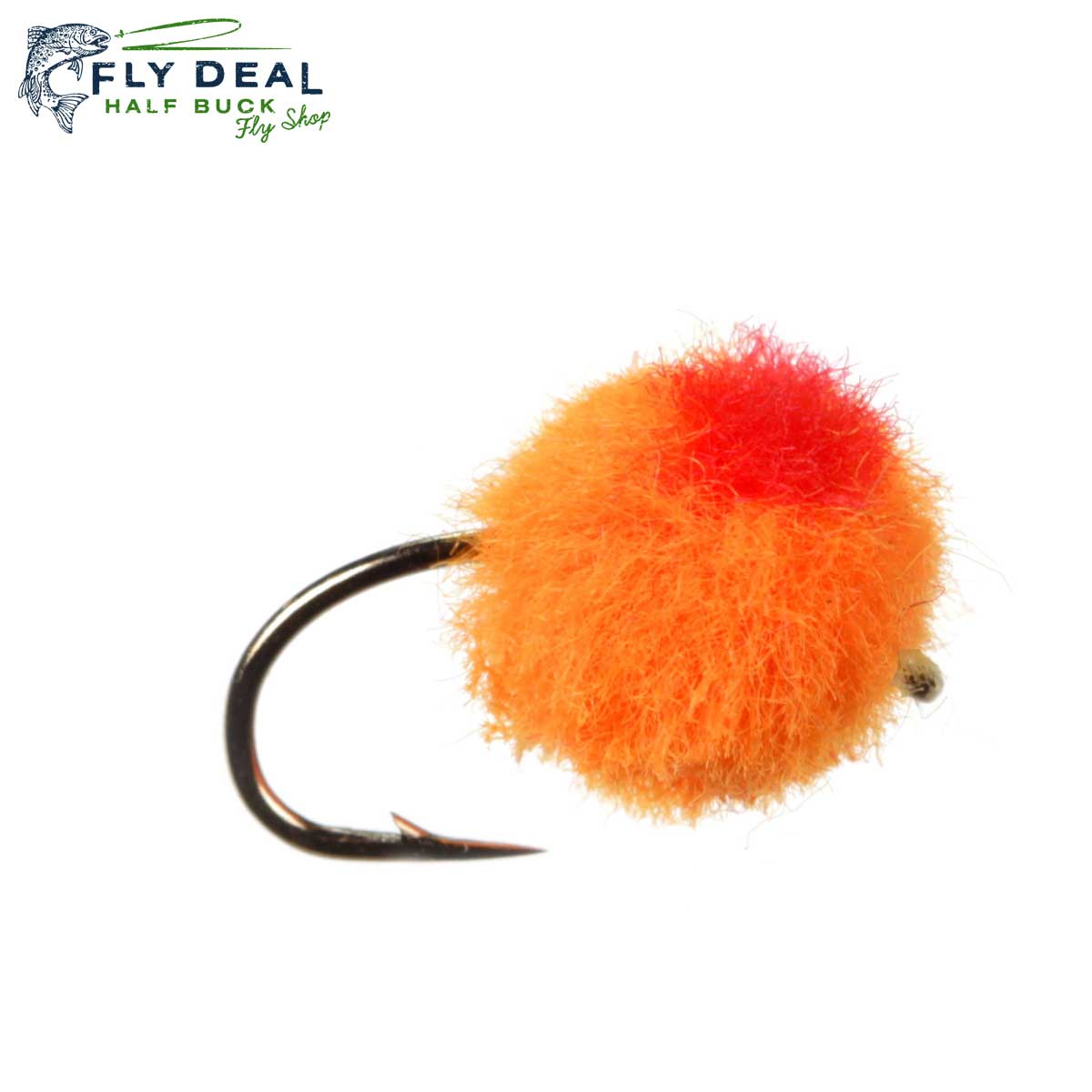 Reference photo
The original yarn egg, still in every Michigan steelhead box in Oregon Cheese, Golden and Chartreuse per Current Works, with a #12 short-shank scud hook the all-around Pere Marquette size and #14 to #16 for low clear water. For salmon, Trails to Trout advises blue, black and chartreuse pre-spawn and red, pink and orange during the spawn, in #6 to #8. Cream and pale yellow versions carry through the winter and the April to May sucker spawn.
Indicator nymphing · Chuck and duck · Euro / tight-line nymphing
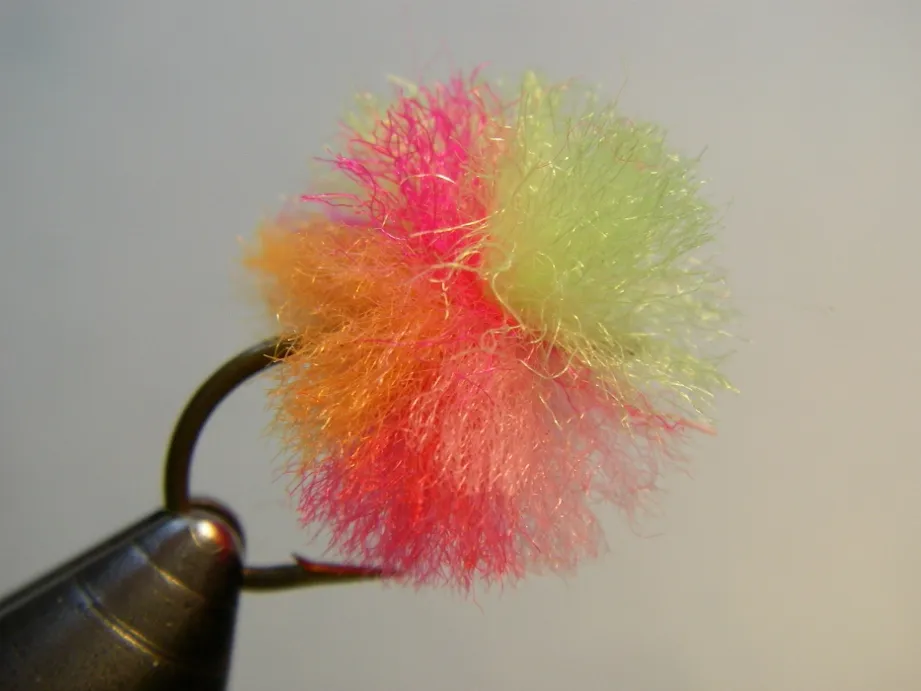 Reference photo
A multi-color yarn rag egg that Hawkins calls 'a deadly fly' under a float on the Manistee and that 'will fool most salmon and steelhead.' Chuck Hawkins sizes it dime-sized in pinks and oranges before runoff, quarter-sized in chartreuse, orange and bright yellow during runoff, and muted afterward; Kraimer fishes a quarter-sized Clown as the attractor above a smaller realistic egg. Fish it under an 8 to 20 g float or chuck-and-duck from fall through April.
Indicator nymphing · Chuck and duck
 Reference photo
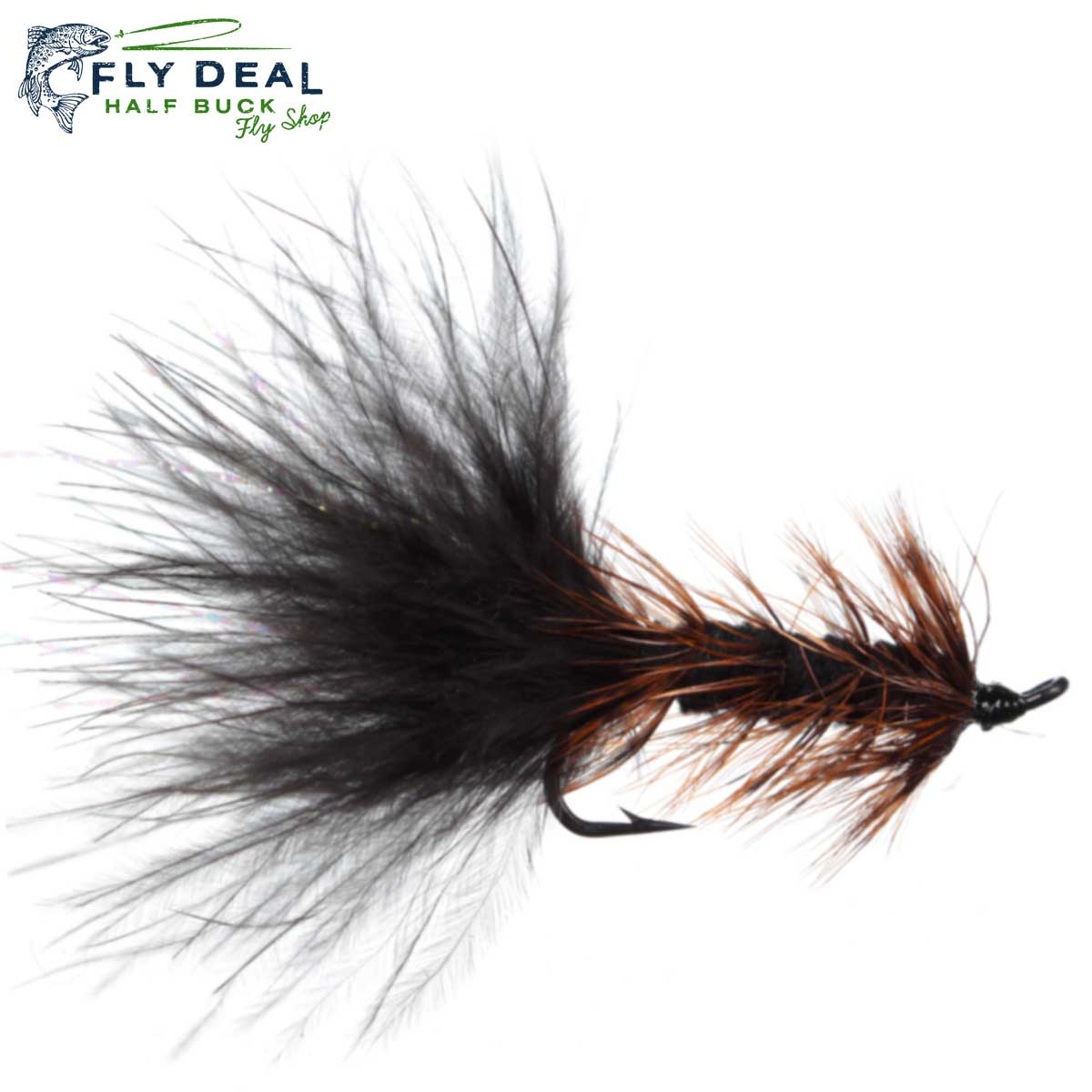
A leech profile with an egg hot spot, recognized as one of the most effective flies on Great Lakes tributary steelhead streams and, per Current Works, less intrusive than most patterns for selective fish. Betts fishes it for Pere Marquette fall salmon, and Michigan coho anglers swing it through runs and tailouts. Dead-drift or swing black, purple or olive bodies with chartreuse, orange, red or pink heads from September through April; #8 versions take pink salmon.
Swinging flies (spey / switch) · Indicator nymphing · Chuck and duck · Streamers
 Reference photo
Current Works' Steelhead Bugger #6 sits in its Michigan top five, and U.P. guides run a beadhead Woolly Bugger #8 in black or green in the nymph rig. Dead-drift it as the point fly with an egg trailing, or swing it through tailouts; it covers leeches, sculpins and crayfish at once.
Indicator nymphing · Chuck and duck · Swinging flies (spey / switch)
 Reference photo
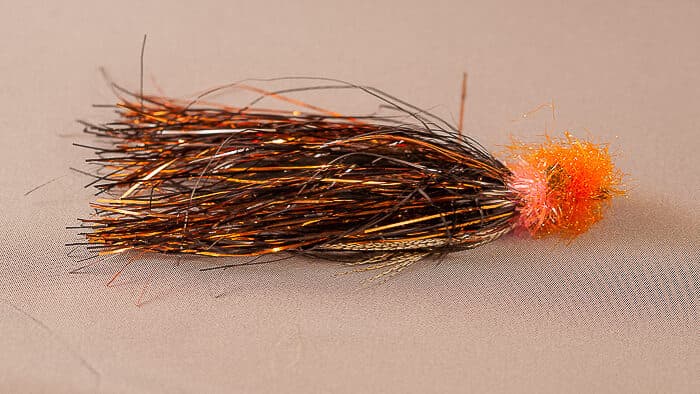
Black marabou and schlappen over peacock and orange Ice Dub with pink and copper Flashabou, on a 25 mm Senyo shank with a trailer or a Daiichi 2461. Originating on the Muskegon, it is 'great through fall' when steelhead have switched from lake alewife to river shiners and respond to flash. Swing it from October through December.
Swinging flies (spey / switch)