Flies / Dry fly
Adams (and Parachute Adams)
ABoardman River, Michigan
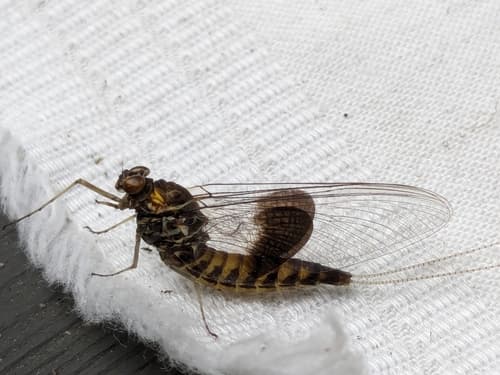
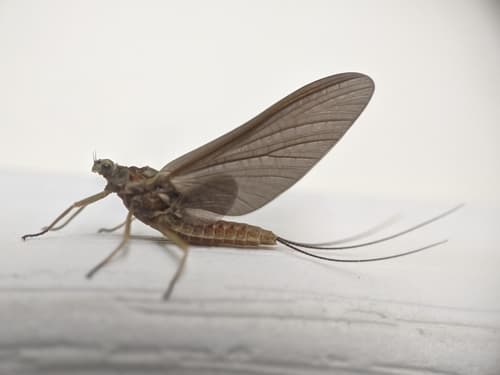
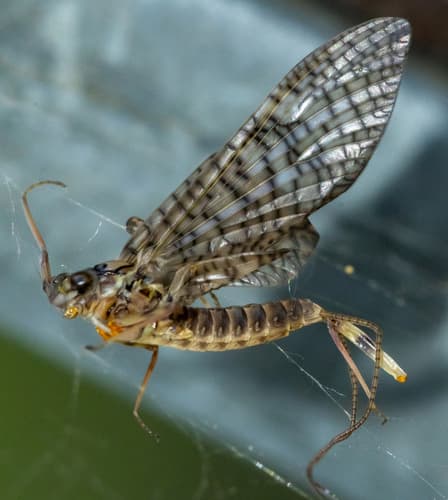
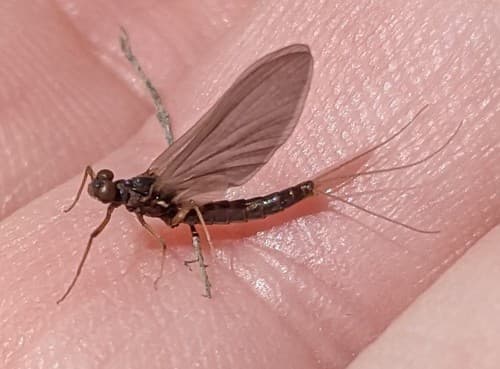
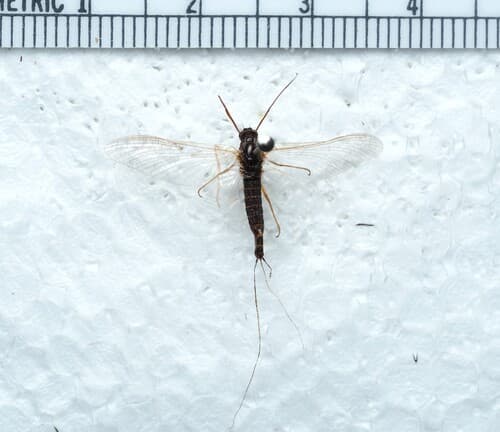
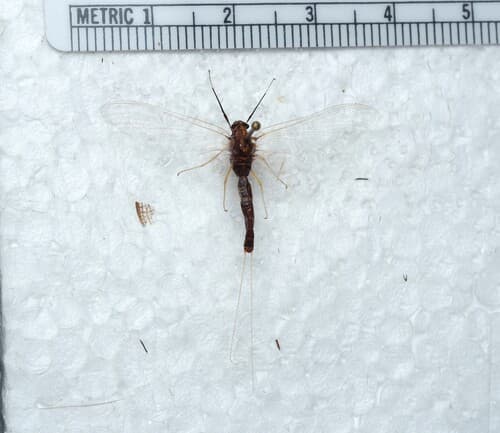
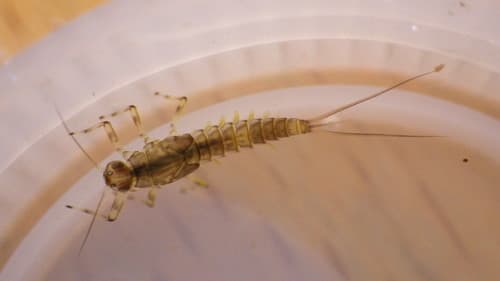
Michigan's own fly, born on the Boardman, and still the default searching dry on every river in the state. Hawkins recommends a slim-tied #10 to #12 Adams for Gray Drake spinner falls at dusk on the Pere Marquette and Muskegon, and smaller sizes pass for most gray-winged mayflies from April through October.
Photo © Quinn for Fly Deal Flies, used with permission · Adams
© Drcooling · CC BY-SA 3.0 · Wikimedia Commons
Mike Cline · Public domain · Wikimedia Commons
© Freyfisher · CC BY-SA 2.0 · Wikimedia Commons
- Jan
- Feb
- Mar
- Apr
- May
- Jun
- Jul
- Aug
- Sep
- Oct
- Nov
- Dec
The naturals
Setups
- Dry fly
Materials
- Hook
- Standard dry-fly hook (Mustad 94840, TMC 100 or equivalent), sizes 10-20
- Thread
- Gray or black, 8/0 or 70 denierBlack is traditional; gray disappears into the body
- Wing
- Two grizzly hen hackle tips, upright and dividedParachute: a post of white calf body hair or white poly yarn instead
- Tail
- Brown and grizzly hackle fibers, mixedParachute tiers often use 6-8 Coq de Leon fibers
- Body
- Gray muskrat fur or Adams-gray Superfine dubbingKeep it slim and tapered; a slim body on a #10-12 is the Michigan Gray Drake tie
- Hackle
- One brown and one grizzly dry-fly hackle, wound togetherParachute: same two feathers wound around the post
- Head
- Tying thread with a drop of head cement
Steps
- 1.Start the thread a couple of eye-widths behind the eye and lay a base back to the wing position, about a quarter of the shank behind the eye.
- 2.Pair two grizzly hackle tips with their curved sides facing each other, measure them to the shank length, and bind them in with the tips pointing forward over the eye.
- 3.Stand the tips upright with a small dam of thread in front of them, then split them with a few figure-eight wraps so they sit as a divided wing.
- 4.Run the thread to the bend and tie in a small bunch of mixed brown and grizzly hackle fibers for a tail about one shank length long.
- 5.Dub a thin noodle of muskrat or gray Superfine and wind a slim, tapered body from the tail up to just behind the wing.
- 6.Prepare one brown and one grizzly hackle with barbs about one and a half hook gaps long, strip the butts, and tie both in behind the wing with the dull sides toward you.
- 7.Wind the first hackle two or three turns behind the wing and two or three in front, tie it off, then wind the second one through the first so the colors mix.
- 8.Trim the tips, build a neat thread head, whip finish and add a drop of cement.
- 9.For the Parachute Adams: post a bunch of white calf hair or poly yarn at the one-third point, wrap a thread base a short way up the post, tie the tail and body as above, tie the two hackles in against the post, dub a small thorax around the post, wind the hackles down the post three to five turns, tie off beneath the hackle and whip finish.
From the tier
- Michigan history: Leonard Halladay of Mayfield tied the fly in 1922 for his friend Charles F. Adams, an Ohio attorney who fished it on the Boardman River near Kingsley; when Adams reported how well it worked, Halladay named it for him.
- Halladay's original carried a gray muskrat or wool body, grizzly tips tied spent or upright, mixed brown-and-grizzly hackle, and a tail of grizzly fibers or golden pheasant tippets.
- Tim Flagler's advice for small parachutes: keep the dubbing sparse and mix the two tail colors in one bunch; the white post is what lets you see the fly in broken water.
Dry Flies - Adams Dry Fly Steps summarize the Orvis Learning Center Adams tutorial for the standard tie and the Fly Fish Food and Tightline parachute tutorials for the parachute; history from Wikipedia and Farm and Dairy. Unconfirmed: Halladay's exact original tail (grizzly fibers vs golden pheasant tippet) is reported both ways; the slim Gray Drake variant is a Michigan shop convention rather than a published dressing. Also checked against Wikipedia, Adams (dry fly), Jim Abrams, Farm and Dairy (2026), The Adams Fly: How a legend was born, Cheech, Fly Fish Food (2019), Parachute Adams and Phil Monahan / Tim Flagler, Orvis News (2022), Video: How to Tie a Tiny Parachute Adams.
Hook and hardware
Standard dry-fly hooks1 per fly
sizes 10-20
Hook
1 per fly
Feathers and fur
Grizzly dry-fly cape or saddle1 cape (wings, tail and hackle)
WingTailHackle
1 cape (wings, tail and hackle)
Brown dry-fly cape or saddle1 cape
TailHackle
1 cape
Adams-gray Superfine dubbing or muskrat fur1 packet
Adams gray / muskrat
Body
1 packet
Coq de Leon tailing feathersoptional1 pack
medium pardo
Tail
Alternative tail for the parachute
1 pack
Synthetics, flash and legs
White calf body hair or white poly yarnoptional1 patch or card
white
Wing
Parachute post only
1 patch or card
Thread and finish
Tying thread1 spool
gray or black, 8/0 / 70 denier
ThreadHead
1 spool
Head cement1 bottle
Head
1 bottle
Sources