Flies / Dry fly
Sly Sister Stone
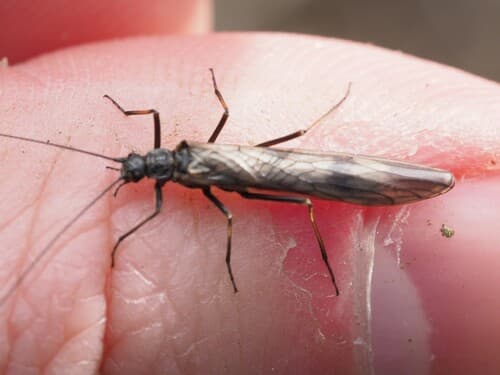
AA CDC-winged adult early black stonefly for the egg-laying flights on warm late-winter afternoons, when females beat their wings continuously on the surface. Fish it noon to 4 pm on the Muskegon and Pere Marquette from late February through April for resident trout and the occasional rising steelhead.
Photo © the photographer, used with permission
- Jan
- Feb
- Mar
- Apr
- May
- Jun
- Jul
- Aug
- Sep
- Oct
- Nov
- Dec
The naturals
Setups
- Dry fly
Materials
- Hook
- Daiichi 1260 2X-long curved dry-fly hook, sizes 12-14
- Thread
- Black, 8/0 or 70 denier
- Body
- Hareline black rabbit dubbing, slim
- Wing
- CDC feathers tied flat over the body, light dun or dark dunSupinski uses darker wings on bright days and lighter wings under dark skies
- Head
- Grizzly hackle palmered through the front third as a head/leg collar
Steps
- 1.Lay a thread base along the curved shank to a point above the barb.
- 2.Dub a thin noodle of black rabbit and wind a slim body forward over about two-thirds of the shank.
- 3.Select two or three CDC feathers of the shade suited to the light and tie them in flat on top so the tips reach just past the hook bend, forming a low tent wing; trim the butts.
- 4.Tie in a grizzly hackle at the front of the wing.
- 5.Palmer the hackle forward through the head area in three or four close turns, then tie it off behind the eye.
- 6.Trim the hackle flat on the underside if you want the fly to sit lower in the film.
- 7.Build a small head, whip finish and treat the CDC with a powder floatant rather than gel.
From the tier
- Supinski fishes a big fluffy CDC dry even when trout seem to be taking nymphs, on an 18-foot leader with 5-7 feet of 4X, delivered with a high puddle cast so it drifts drag-free in backwater seams; he avoids dry-dropper rigs over selective fish.
- Early black stoneflies (Allocapnia and Taeniopteryx) run February through May on Midwest streams, with the best activity from about 1 to 4 pm on sunny afternoons once water reaches the mid-30s F.
- Tim Flagler's Little Black Stonefly is the classic alternative: a CDC body, a grizzly hackle clipped underneath and a down-wing, fished in the film once fish start rising.
Cold Stoned - Early Blacks Demystified Materials are Supinski's published list from Hallowed Waters; the step order is a standard CDC down-wing stonefly sequence since his article gives the dressing but not the steps. Unconfirmed: Hook size is not stated in the source (12-14 is our assumption); only one published source exists for the dressing; the Newaygo/Muskegon attribution is from Supinski's general biography, not the fetched page. Also checked against Phil Monahan / Tim Flagler, Orvis News (2015), Video: How to Tie the Little Black Stonefly.
Hook and hardware
Daiichi 1260 hooks1 per fly
sizes 12-14 · Daiichi
Hook
1 per fly
Feathers and fur
Rabbit dubbing1 packet
black · Hareline
Body
1 packet
CDC feathers1 pack each
light dun and dark dun
Wing
1 pack each
Grizzly dry-fly saddle1 saddle
Head
1 saddle
Thread and finish
Tying thread1 spool
black, 70 denier
Thread
1 spool
Sources