Flies / Nymph
Spring Wiggler
AMichigan steelhead fly, in use over fifty years
A yellow chenille and fox squirrel Hex nymph that has been a Michigan steelhead fly for more than fifty years. Schrems West Michigan TU calls it effective year-round and especially in winter on the Muskegon. Dead-drift it on the bottom in runs below gravel; the bright variants double as an attractor in stained water.
Photo © Jackson Hole Fly Company, used with permission
- Jan
- Feb
- Mar
- Apr
- May
- Jun
- Jul
- Aug
- Sep
- Oct
- Nov
- Dec
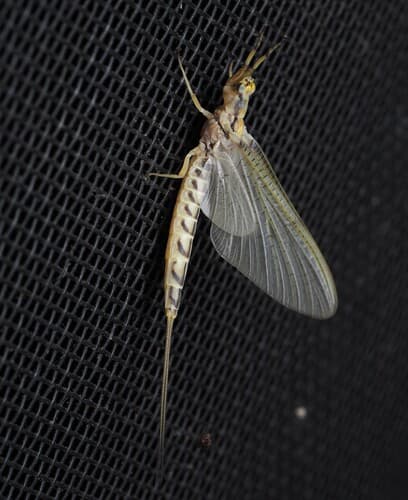
The naturals
Setups
- Indicator nymphing
- Chuck and duck
Materials
- Hook
- Mustad 3906B or TMC 200R, sizes 4-10Nomad Anglers ties a #4 200R for steelhead; #6-10 is the usual range.
- Thread
- 6/0, black or brown
- Weightoptional
- Lead-free wire, small gaugeOptional so the profile stays slim; some tiers add small bead-chain or mono eyes instead.
- Tail
- Red fox squirrel tail hairLeave the butts long; they become the shellback.
- Riboptional
- Gold wireUsed in the Muskegon original to bind the shellback down through the hackle.
- Body
- Medium chenille, yellowYellow was the original colour; orange, chartreuse, olive, tan and brown are all standard now, and flashier chenilles or hot butts are common.
- Hackle
- Soft brown or grizzly saddle hackle, palmered the full length of the body
- Shellback
- The same fox squirrel hair pulled forward over the backHalf to two thirds of the tail bundle is brought forward; a coat of UV resin on it adds durability.
Steps
- 1.Start the thread behind the eye and run it to the bend. Add a few turns of small wire under the body if you want the fly to fish deep.
- 2.Clean the short underfur out of a bundle of fox squirrel tail and tie it in at the bend so the tips extend about one hook gap past the bend. Do not cut the butts; bind them back along the shank so they stick out over the tail with the tips.
- 3.Tie in the gold wire rib, if using, and the saddle hackle by its butt at the bend.
- 4.Strip the fuzz from the end of the chenille to expose the core, tie the core in at the bend, and wrap the chenille forward in touching turns to just behind the eye. Tie off and trim.
- 5.Palmer the hackle forward through the chenille in open turns, tie it off behind the eye and trim.
- 6.Separate half to two thirds of the squirrel hair from the tail, pull it forward over the top of the body, hold it firmly and bind it down behind the eye.
- 7.If you used a rib, spiral the gold wire forward over the shellback and through the hackle, wiggling it so it traps as few hackle fibres as possible, and tie it off.
- 8.Trim the squirrel butts, build a neat head, whip finish and cement. A thin coat of UV resin over the shellback is optional.
- 9.Trim the hackle short on top if you want a slimmer, more nymph-like profile; leave it full for the classic buggy look.
From the tier
- Dick Smith (Schrems West Michigan TU) says the pattern has caught steelhead every winter for more than fifty years and is still the standard steelhead fly stocked by Michigan tackle stores.
- Nomad Anglers fishes it three ways depending on water: dead-drifted with or without an indicator, swung, or stripped.
- Global FlyFisher notes it grew from watching centre-pin anglers drift live wigglers; tie it big, and vary the body colour rather than the construction.
Nymph fishing for steelhead - Schrems West Michigan Trout Unlimited Recipe and history follow Dick Smith's SWMTU article; the step order follows the Tight Lines and Nomad Anglers write-ups, with the wire-over-shellback detail from Smith. Unconfirmed: The Michigan Sportsman forum recipe (Mustad 3906, wingcase of squirrel, palmered saddle) was visible only in search snippets because the thread is paywalled; the date of origin is given only as 'over fifty years' by SWMTU. Also checked against Paul D, Tight Lines Fly Fishing (2019), Tight Lines Fly Fishing: Paul's March 2019 Fly of the Month (Spring's Wiggler), David Lilly, Nomad Anglers (2017), Nomad Angler Presents - Fly of the Month (Michigan Wiggler) - Coastal Angler & The Angler Magazine and Piscator Flies, Global FlyFisher (2018), Michigan Wriggler (aka Spring Wriggler) | Global FlyFisher.
Hook and hardware
Wet-fly or curved nymph hook1
size 4-10 · Mustad 3906B or Tiemco 200R
Hook
1
Feathers and fur
Red fox squirrel tail1 tail
natural
TailShellback
1 tail
Saddle hackle1 feather
brown or grizzly
Hackle
1 feather
Synthetics, flash and legs
Chenilleabout 8 in
medium, yellow (or orange, chartreuse)
Body
about 8 in
Thread and finish
Tying thread1 spool
6/0 black or brown
Thread
1 spool
UV resin or head cementoptional1
Shellback
1
Other
Lead-free wireoptionalabout 4 in
small gauge
Weight
about 4 in
Gold wireoptionalabout 6 in
small
Rib
about 6 in
Sources