Flies / Nymph
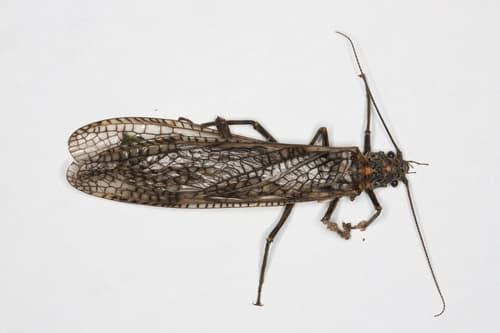
Giant Black Stonefly Nymph (Pteronarcys)
APteronarcys dorsata nymphs live two to four years, so the #2 to #6 nymph is available all year and is the Pine River staple, where Hawkins calls it a river of nymphs, sculpins and baitfish rather than a surface river. Bounce it through fast pockets on the Pine, Sturgeon and Upper Manistee; the adults emerge sporadically at night from mid May to June and are rarely fished.
Photo © Quinn for Fly Deal Flies, used with permission · (K) Stone Black - Beadhead
- Jan
- Feb
- Mar
- Apr
- May
- Jun
- Jul
- Aug
- Sep
- Oct
- Nov
- Dec
The naturals
Setups
- Indicator nymphing
- Euro / tight-line nymphing
- Chuck and duck
Materials
- Hook
- TMC 200R or 3XL heavy nymph hook (TMC 5263), sizes 2-8Curved 200R gives the natural's crouch; do not bend a tempered hook to shape.
- Thread
- Danville 6/0, black
- Weight
- Lead-free wire .030Two lengths lashed along the sides of the shank for width, plus 8 or so wraps under the thorax.
- Antennae
- Black turkey biots, twoTied in behind the eye, about half a shank long.
- Tail
- Black goose biots, twoSplit over a small dubbing ball, one hook gap long.
- Rib
- Black or brown vinyl rib (V-Rib or D-Rib), medium to largeReplaces the original Swannundaze; 6-7 visible wraps on the abdomen.
- Abdomen
- Kaufmann black stone dubbing blendThe original is about 60 percent Angora goat in black, purple, claret, fluorescent red, ginger, brown, kingfisher blue and burnt orange, mixed with 40 percent black Haretron; a pre-mixed Kaufmann Blend or any coarse black stonefly dubbing works.
- Wingcases
- Black Swiss straw or lacquered mottled turkey tail, three notched sectionsEach section is cut a little wider than the one before it.
- Thorax
- Same black dubbing blend, built fat
- Legsoptional
- Black round rubber, mediumThe rubber-leg version Kaufmann added in the early 1990s.
- Head
- Dubbing over the thread wraps, whip finished in front of the antennae
Steps
- 1.Lash a length of .030 wire along each side of the shank from a couple of eye widths behind the eye to above the barb, then wrap a third piece around the shank about eight turns over the front half. Soak the wraps with super glue so the underbody is wide, flat and solid.
- 2.Tie in two black turkey biots behind the eye, one on each side, tips forward and about half a shank long, and bind the butts back over the wire.
- 3.Build a small ball of dubbing at the rear of the shank, then tie one goose biot on each side in front of it so the tails splay, about one hook gap long.
- 4.Tie in the vinyl rib on top of the shank, flat side out, and bind it back to the tails.
- 5.Dub a stout, tightly twisted abdomen forward to about the 60-70 percent point, keeping the taper thick; the natural is a wide, heavy insect.
- 6.Spiral the rib forward, spacing the turns about two rib widths apart so six or seven segments show, and tie off at the front of the abdomen.
- 7.Cut three wingcase sections from treated turkey or Swiss straw, each about a hook gap wide, fold lengthwise and clip one end to a notch. Tie the first section in at the front of the abdomen with the notch pointing back.
- 8.If you want rubber legs, tie one strand across the shank on each side at this point and again after the next wingcase so three pairs stick out sideways.
- 9.Dub forward a short distance, tie in the second wingcase so its notch sits at the middle of the first, dub again and add the third wingcase the same way, finishing two eye lengths behind the eye.
- 10.Dub a small head to cover the wraps, whip finish in front of the antennae and cement. Trim the rubber legs to about a shank length.
From the tier
- Kaufmann's own tip is that the fly works because it gets size, shape and colour right at once: make the body fat and oversized, weight it heavily, and fish it on the bottom.
- Phil Rowley finishes the abdomen at the 50-60 percent point to leave room for three wing pads and a real thorax, and coats turkey wingcases with flexible cement so they do not split.
- Fish it dead-drift along the bottom of riffles and along the banks, especially in the weeks the nymphs migrate toward shore ahead of the hatch; in Michigan that is late May into June for Pteronarcys.
Kaufmann Stones - a strong pattern developed over time - Fly Fishing the Sierra Steps summarize the Kaufmann Stone sequence on Fly Fishing the Sierra and Phil Rowley's BC Outdoors article, using the black stone materials; the In The Riffle video page could not be reached. Unconfirmed: Fly Fishing the Sierra lists the recipe under Kaufmann's name but the page is the site owner's write-up of his book Tying Nymphs; the exact 1973 dubbing blend is reproduced from that page and could not be checked against the book. Also checked against Phil Rowley, BC Outdoors Magazine (2014), Fly-Tying: The Kaufmann Stone - BC Outdoors Magazine and John Kreft, RiverKeeper Flies (2017), Kaufmann's Stonefly Nymph - RiverKeeper Flies.
Hook and hardware
Curved or 3XL nymph hook1
size 2-8 · Tiemco 200R or 5263
Hook
1
Feathers and fur
Turkey biots2 biots
black
Antennae
2 biots
Goose biots2 biots
black
Tail
2 biots
Stonefly dubbing blenda generous pinch
Kaufmann black stone blend or coarse black
AbdomenThoraxHead
a generous pinch
Synthetics, flash and legs
Vinyl rib (V-Rib or D-Rib)about 8 in
medium or large, black or brown
Rib
about 8 in
Swiss straw or mottled turkey tail1 strand or 1 feather
black
Wingcases
1 strand or 1 feather
Round rubber legsoptional3 strands
medium black
Legs
3 strands
Thread and finish
Tying thread1 spool
6/0 black · Danville
Thread
1 spool
Super glue1
Weight
1
Flexible cementoptional1
Wingcases
Only needed if you use turkey tail instead of Swiss straw.
1
Other
Lead-free wireabout 10 in
.030
Weight
about 10 in
Sources