Flies / Nymph
Pat's Rubber Legs
AA U.P. steelhead guide's nymph rig runs double-bead stoneflies and Pat's Rubber Legs #8 to #10 in black and brown as the point fly ahead of an egg or caddis. For trout it is a generic big stonefly for the Pine, Upper Manistee and Sturgeon, fished deep in fast water year-round; Michigan trout sources do not name it, so treat the trout use as generic.
Photo © Quinn for Fly Deal Flies, used with permission · (K) Stone Rubber Legs Black
Photo © Quinn for Fly Deal Flies, used with permission · (K) Stone Rubber Legs Brown
- Jan
- Feb
- Mar
- Apr
- May
- Jun
- Jul
- Aug
- Sep
- Oct
- Nov
- Dec
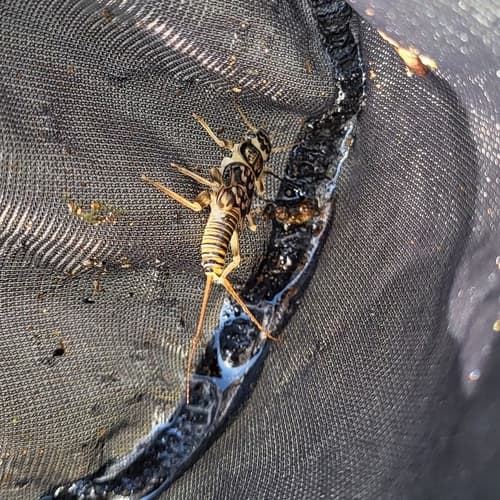
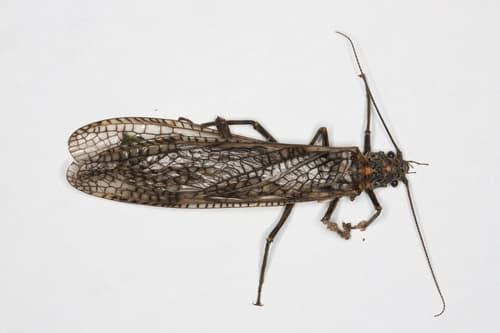
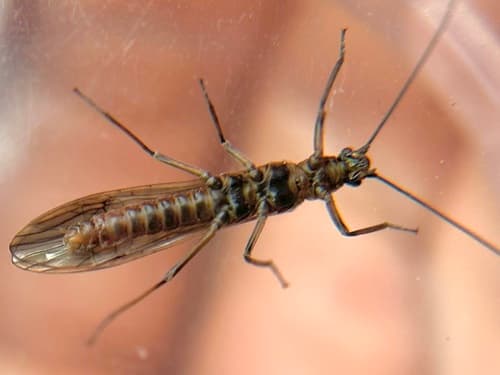
The naturals
Setups
- Indicator nymphing
- Chuck and duck
- Euro / tight-line nymphing
Materials
- Hook
- 3X-long nymph hook, sizes 4-12 (Dai-Riki 710, TMC 5262/5263, Risen 300)Our box runs 4-10.
- Weight
- .015 lead-free or lead wire (up to .025 on big hooks), 10-20 wraps
- Thread
- Black or brown 6/0 (Veevus 6/0) or 140 denier
- Tails and antennae
- Spanflex, Flexi-Floss or Lifeflex in black, brown or ginger; one strand folded at each end
- Body
- Variegated chenille, medium (small on 10-12): black and coffee is the classicBrown/yellow (GFF's tie), plain black, and olive/brown cover our colour list.
- Legs
- Three strands of the same Spanflex tied crosswise
- Head cementoptional
- Head cement, or thin UV resin (Solarez Ultra Thin) used to lock the legs
Steps
- 1.Debarb the hook, start the thread behind the eye, and wrap lead-free wire over the middle 60-70 percent of the shank. Bind the wire down and build thread ramps at both ends so the chenille will lie evenly.
- 2.At the rear, lay a strand of Spanflex across the top of the shank and figure-eight it so two tails splay to either side. Stretch the strand as you bind it so it seats tight, and trim the ends later.
- 3.Strip a little fuzz from the end of the chenille to expose the core and tie it in at the base of the tails.
- 4.Advance the thread and tie in three leg strands crosswise with figure-eight wraps: the first about a third of the shank behind the eye, the second a couple of eye-lengths forward of that, and the front pair right behind the eye so its forward ends double as antennae. Pat Bennett's original method secures each pair one at a time; a drop of UV resin over the crossings is the modern shortcut.
- 5.Wrap the chenille forward in tight touching turns. At each leg pair, pull the legs back out of the way with your off hand or plunger hackle pliers and pass the chenille in front of them so nothing gets trapped.
- 6.Tie off the chenille behind the eye, trim, build a small thread head, whip finish and cement.
- 7.Stretch and trim the legs and tails to about a gape and a half, the antennae a little shorter; stretching before the cut lets the strands spring back to an even length.
From the tier
- Global FlyFisher's McFly Angler video shows Bennett's original technique, each leg tied in individually, and calls it possibly the easiest guide-style stonefly there is.
- Phil Monahan (Orvis) reports black-and-coffee is a favourite of Rocky Mountain guides as a year-round searching pattern, and that UV resin takes the frustration out of the legs.
- Michigan: DIY Fly Fishing lists Pat's Rubber Legs in 4-12 for resident trout on the Muskegon below Croton Dam; Kraimer notes Michigan rivers hold stoneflies from tiny black ones up to two-inch nymphs, so carry a spread of sizes.
Pats Rubber Legs Original Steps combine the Global FlyFisher (original individual-leg) and Orvis (UV-resin) methods; both pages describe the sequence in prose and video rather than numbered text steps. In The Riffle's tutorial was unreachable. Unconfirmed: The exact year of origin (late 1990s by most accounts) came from a search snippet rather than a fetched page. Also checked against Phil Monahan, Orvis News (video by Tim Flagler), 2016, Video: How to Tie the Pat's Rubber Legs and DIY Fly Fishing (2022), DIY Guide to Fly Fishing the Muskegon River in Michigan.
Hook and hardware
3X-long nymph hooks1 pack of 25
sizes 6-10 · Dai-Riki 710 or TMC 5263
Hook
1 pack of 25
Synthetics, flash and legs
Spanflex or Flexi-Floss1 pack
black (add brown)
Tails and antennaeLegs
1 pack
Variegated chenille1 card each
black/coffee, brown/yellow; medium
Body
1 card each
Thread and finish
Thread1 spool
black or brown 6/0 or 140 denier
Thread
1 spool
UV resin or head cementoptional1 bottle
Solarez Ultra Thin
Head cement
1 bottle
Other
Lead-free wire1 spool
.015 (.020 for size 4-6)
Weight
1 spool
Sources