Flies / Nymph
Hex Nymph (Wiggler)
ACurrent Works' number one Michigan steelhead fly, because most steelhead rivers (Muskegon, Manistee, Pere Marquette, Au Sable, St. Marys) hold silt-burrowing Hexagenia and trout may see up to 2,000 nymphs a day outside the hatch. Fish #6 to #8 under an indicator or chuck-and-duck year-round for steelhead, in the two weeks before the June hatch for trout, and in July for St. Marys Atlantic salmon.
Photo © Quinn, used with permission
Photo © Kevin Feenstra, used with permission · Kevin Feenstra AP Hex
- Jan
- Feb
- Mar
- Apr
- May
- Jun
- Jul
- Aug
- Sep
- Oct
- Nov
- Dec
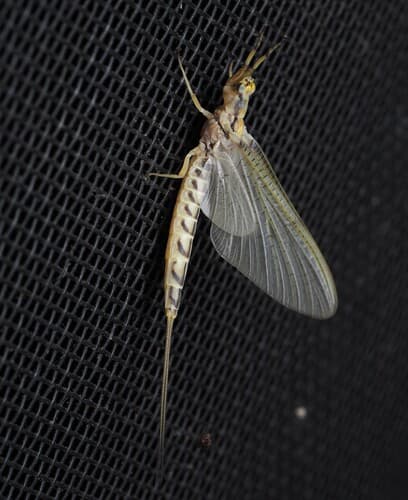
The naturals
Setups
- Indicator nymphing
- Chuck and duck
- Euro / tight-line nymphing
Materials
- Hook
- Daiichi 1720 3XL nymph, sizes 4-10Kraimer ties a #6; he prefers the 1720 over a TMC 200R for steelhead so the hook does not open. Tie #10 for young-of-year nymphs.
- Thread
- Uni 6/0, tan
- Weightoptional
- Lead or lead-free wire, .025Wrapped on the front third of the shank.
- Tail
- Gray marabou from a pheasant or grouse skinTied a little long, about one shank length, for extra swimming motion.
- Back
- Mottled turkey tail slip, coated with Flex Seal or flexible cementOne long slip does double duty: it is laid over the abdomen, then folded forward again as the wingcase.
- Gills
- Aftershaft (filoplume) feather from pheasant or grouseLaid flat over the abdomen so the fluffy fibres trail along each side.
- Rib
- Small gold wireWound through the gills without trapping them.
- Abdomen
- Cream rabbit dubbingSlightly tapered.
- Thorax
- Cream rabbit dubbingShort and noticeably fatter than the abdomen.
- Wingcase
- Same turkey tail slip as the back, folded forward
- Legs
- Grizzly hen saddle featherTwo turns through the thorax.
- Eyes
- Small black mono eyes
Steps
- 1.Start the thread behind the eye and lay a base back to a point above the barb. If you want weight, wrap .025 wire over the front third of the shank now.
- 2.Tie in a gray marabou tail above the barb, tips reaching back about one shank length.
- 3.Cut a narrow slip of treated turkey tail and tie it in at the tail with the coated side up, then tie in the gold wire at the same point.
- 4.Dub a lightly tapered abdomen forward, stopping about one hook gap short of the eye.
- 5.Lay the aftershaft feather over the top of the abdomen, bind it down at the front and trim the stem.
- 6.Pull the turkey slip forward over the aftershaft, tie it down at the front of the abdomen but do not cut it; it will become the wingcase.
- 7.Counter-wind the wire rib forward through the abdomen, wiggling it between the gill fibres so none are trapped. Tie off and trim.
- 8.Fold the turkey slip back over itself toward the tail and lock it with a few wraps so it points rearward.
- 9.Dub a short, fat thorax, then figure-eight a pair of small mono eyes just behind the hook eye.
- 10.Tie in the grizzly hen feather by its tip at the back of the thorax, dub up to (not over) the eyes, take about two turns of hackle through the thorax, and tie off.
- 11.Add a pinch of dubbing around the eyes to hide the thread, then pull the turkey slip forward over the thorax, splitting the hackle evenly to each side. Tie off behind the eye, trim, whip finish and cement.
From the tier
- Kraimer says the marabou, aftershaft and hen hackle are chosen for movement so the fly looks like a swimming nymph; he ties the tail a touch longer than the natural for that reason.
- Bear Andrews' Bear's Hex (Umpqua) is a similar dubbing-and-hackle-leg tie in #6 with a reputation on the lower Au Sable, Pere Marquette and Manistee; Schultzy's Rabbit Hexum (Rainy's, #8, natural) and Ted's Edible or Swimming Hex use a rabbit-strip abdomen for an even wigglier body, tied on a curved hook with the eyes on top so the point rides up.
- Steelhead fish it dead-drift under an indicator; for trout before and during the hatch, swim it slowly with short strips or bumps and squeeze water into the rabbit before the first cast.
Hex Nymph for Trout and Steelhead - Current Works Guide Service Steps summarize Ted Kraimer's Current Works hex nymph tutorial in our own words; the rabbit-strip variant notes come from his Swimming Hex page and Nomad Anglers' Wiggle Hex, and the Bear's Hex and Rabbit Hexum notes come from catalogue pages that do not publish recipes. Unconfirmed: No published recipe was found for Schultzy's Rabbit Hexum or a fly called exactly 'Ted's Edible Hex'; we describe them from the catalogue photos and Kraimer's Swimming Hex, which uses the same rabbit-strip construction. Also checked against Ted Kraimer (first published in Fly Tyer, Spring 2010), How to tie Ted's Swimming Hex Nymph Fly Pattern - Current Works, Umpqua Feather Merchants (Jeff 'Bear' Andrews, signature tyer), Bear's Hex - Freshwater Nymph - Umpqua Feather Merchants, Nomad Anglers (2022), Wiggle Hex Nymph Tying Tutorial | Nomad Anglers and Rainy's Flies, Schultzy's Rabbit Hexum - Natural - rainysflies.
Hook and hardware
Nymph hook, 3XL1
size 4-10 · Daiichi 1720
Hook
1
Mono eyes1 pair
small black
Eyes
1 pair
Feathers and fur
Pheasant or grouse skin (gray marabou and aftershaft)1 skin or a small patch
natural gray
TailGills
1 skin or a small patch
Mottled turkey tail1 feather
oak or cinnamon mottled
BackWingcase
Coat with Flex Seal or flexible cement before cutting slips.
1 feather
Rabbit dubbinga pinch
cream
AbdomenThorax
a pinch
Hen saddle1 feather
grizzly
Legs
1 feather
Thread and finish
Tying thread1 spool
6/0 tan · Uni
Thread
1 spool
Flexible cement or Flex Sealoptional1
BackWingcase
1
Other
Lead-free wireoptionalabout 6 in
.025
Weight
about 6 in
Gold wireabout 6 in
small
Rib
about 6 in
Sources